Showing posts with label Economy. Show all posts

Thursday, June 23, 2011

"The end of Growth", Richard Heinberg's new book

The world's biggest economy will expand between 2.7pc and 2.9pc this year, weaker than it expected just two months ago. The latest evidence from manufacturing, the housing market and the consumer – still the engine of the economy – all suggest the deterioration that started in the first quarter of this year has extended into the second.
"Part of the slowdown is temporary, part of it may be longer lasting," said Fed chairman Ben Bernanke. "We don't have a precise reading on why this slower pace of growth is persisting." "Economists insist that recovery is at hand. Yet, unemployment remains high, real estate values continue to sink, and governments stagger under record deficits. The End of Growth proposes a startling diagnosis: humanity has reached a fundamental turning point in our economic history. The expansionary trajectory of industrial civilization is colliding with non-negotiable natural limits."The End of Growth describes what policymakers, communities, and families can do to build a new economy that operates within Earth’s budget of energy and resources. We can thrive during the transition if we set goals that promote human and environmental well-being, rather than continuing to pursue the now-unattainable prize of ever-expanding GDP." http://richardheinberg.com
Is the beginning of a new era of progress without growth?

Friday, June 17, 2011

The obscure disease of the West

Yesterday I was leafing through some newspapers on the net when a China Daily's article caught my eye. I couldn't believe it was true.
The Chinese Ministry of Commerce (MOC) spokesman Yao Jian said Chinese companies invested $20.35 billion in non-financial sectors in 110 countries and regions during the first five months, up 42.3 percent year-on-year. Chinese companies investing overseas should abide by local laws and should not be discriminated against, he added.
Well, what can I say?
I guess we will have big big troubles with China in the next few years.

Friday, June 10, 2011

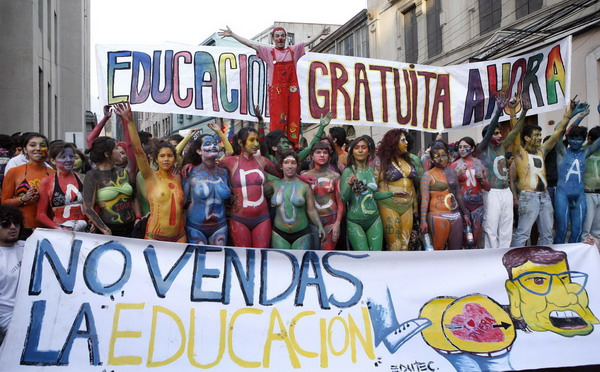
Chilean students get naked in the name of education

In Valparaiso, about 121 km (75 miles) northwest of Santiago, students marched through the streets to demand the government change the public state education system. The banners say: "Free Education now".
From Europe to Midlle East to America people are asking for the same things: Rights, Freedom, Future, Health.
Since the panic of 2008 Britain, US, European Union and Japan spent $5 trillion in quantitative easing to save those "self-styled masters of the universe" from Wall Street. 
Why do we never find money for what people really want?
In the meanwhile, China has allocated a total of 10.3 billion yuan ($ 1.58 billion) this year to reward outstanding college students and provide aid to those with financial difficulties.
Who is wrong?

Prominent Swiss Politician Calls For Arrest of Kissinger at Bilderberg

A prominent member of Switzerland’s largest political party has called upon federal authorities to arrest Henry Kissinger as a war criminal if he attends the 2011 Bilderberg conference of global power brokers at the Hotel Suvretta House in St. Moritz.
Swiss People’s Party representative Dominique Baettig wrote a letter to the General Prosecutor of the Swiss Federation in which he asked, “In the name of Cantonal Sovereignty and independence, but especially of the Justice’s independence from executive power – may it be Federal or Cantonal – I ask you to check abroad for Arrest Warrants delivered by various Courts, Judges and also for all valid criminal complaints against the persons who were, amongst others, cited as mere examples in my (enclosed) letters to Mrs. Simonetta Sommaruga, Federal Counselor and Mrs. Barbara Janom Steiner, Cantonal Counselor and of course, to arrest them before diligent extraditions.”
Baettig’s letter also calls for the apprehension of George W. Bush and French President Nicolas Sarkozy, but neither are likely to be attending the conference. However, Kissinger is a regular Bilderberg attendee and is almost certain to be present in St. Moritz.
Kissinger, National Security Advisor and later Secretary of State for President Nixon and President Ford, has been accused of being complicit in a number of war crimes in Indochina, Bangladesh, Chile, Cyprus and East Timor. Numerous activists have attempted to arrest him over the years under the Geneva Conventions Act.
Prison Planet.com

Monday, May 23, 2011

Generation 2.0: Do you want to make more money? A good friend is all you need

Are you tired to watch your money go up and down?... keep in touch with your schoolmates.
Harvard Business School's Lauren Cohen and Christopher J. Malloy, along with University of Chicago colleague Andrea Frazzini, investigated the ties between more than 1,800 sell-side analysts and the management of public firms, and the subsequent performance of stock recommendations. The study is titled "Sell-side school ties" and suggests that agents in financial markets can gain informational advantages through social networks. Data on the educational background of sell-side analysts and senior corporate officers shows that analysts outperform by up to 6.60% per year on their stock recommendations when they have an educational link to a company.
It seems to be what happened with Raj Rajaratnam.
In 2009 he was arrested by the FBI on allegations of insider trading and on May 11, 2011 was found guilty of conspiracy and securities fraudnews. With more than $60 million, it was the largest hedge fund insider trading case in United States history. Rajaratnam allegedly profited from information received from Robert Moffat, an IBM executive, Rajiv Goel, an Intel Capital executive, and Anil Kumar, a McKinsey & Company executive. It was reported that Rajaratnam, Goel and Kumar were all of class of 1983 from Wharton business school.
According to a famous saying, who finds a friend, finds a treasure! 

Wednesday, May 11, 2011

Capitalism at it's finest

A 78 percent return. $726 million profit. John Paulson, the hedge fund king, put his money on the collapse of Lehman Brothers. Paulson, in fact, bought Lehman bonds after the collapse of the bank at an average price of 13 cents per dollar.
Now with any plan to get some compensation to creditors, according to Wall Street Journal, Paulson will come out with his pockets full of money. 
If, therefore, even the rival plan sponsored by Goldman Sachs was approved, Paulson would earn $350 million. However, at least another hedge fund still could contend the prize for the most profitable bet on Lehman: the unknown Owl Creek Asset Management may make a profit of $71.6 million, a yield of 94% on the initial investment. Money makes money

John Paulson is not related to former Goldman Sachs CEO and U.S. Treasury Secretary Hank Paulson.

Friday, May 6, 2011

Will we ever see anyone caring for our poor asses?

Many people from Wall Street think inflation is now the biggest threat to the U.S. economy. In Brooklyn many more than Wall Steet's rather think the biggest threat is falling into another recession. 
Who is right?
Meanwhile the most significant economic news from the first quarter of 2011 is the decline in real wages. 
In fact, millions of Americans, in order to keep their jobs, are accepting lower wages. 
What do you get like this?
The only thing you get is consumers who can't buy enough to keep the economy going.
Why doesn't Wall Street get it?

Friday, April 29, 2011

Generation 2.0: List of Demands by March 15 in Dar'a, Syria

This statement was originally issued in Arabic by Dir'a's Youth of March 15. The English translation was made available by The Angry Arab News Service.]

Leadership of the Glorious Revolution of the Youth of 15 March, Diraa – Syria

To the Syrian people; to the descendants of Salih al-Ali, Sultan Pasha al-Atrash, Ibrahim Hananou; to all the free people of Syria in all the provinces of Syria; to all the sons of the proud Arab tribes; to the Kurdish brothers; and to all the sects and nationalities with whom we share life on the land of this nation.

We promise you to continue our revolution until this criminal regime which kills its sons in cold blood is brought down. We hope all the brothers will come out tomorrow God willing in million-person demonstrations and announce civil disobedience and refusal to go to work centers and to join your brethren in this glorious revolution and to support your brethren in the province of Diraa, Latakia, Homs, az-Zabdani, Douma, Daria, al-Kiswa, Damascus, at-Tal, and the rest of the provinces revolting until the regime is brought down and the goals of the revolution are achieved which are:

How Asia Copes with America’s Zombie Consumers

NEW HAVEN – Asia needs a new model consumer. A post-crisis generation of zombie consumers in the United States is likely to hobble growth in global consumption for years to come. And that means that export-led developing Asia now has no choice but to turn inward and rely on its own 3.5 billion consumers.
Of course, this is not the first time that Asia has had to cope with the walking economic dead. Japan’s corporate zombies were at the epicenter of its first lost decade in the 1990’s. Sclerotic companies were put on life-support credit lines by their zaibatsu – like banking partners – delaying their inevitable failure and perpetuating inefficiencies and disincentives that resulted in a post-bubble collapse in Japanese productivity growth.

Similarly, the crisis of 2008-2009 led to zombie-creating bailouts in the West. From Wall Street to AIG to Detroit, the US was quick to rescue corporate giants that would have failed otherwise. Britain and Europe did the same, throwing lifelines to RBS, HBOS-Lloyds, Fortis, Hypo Real Estate, and others. In the West, the excuse was too big to fail. How different is that from Japan’s mindset nearly 20 years ago?

Friday, April 8, 2011

US shutdown: regrettably, yes. But it is, you know, a sacrifice required for the future of the human race

Sometime ago Senate Majority Leader Harry Reid called Chinese President Hu Jintao a "dictator". It was surely right but it wasn't ok. Why?.
When questioned on congressional Democrats' end-of-year compromise with Republicans that gave tax cuts to America's highest earners, Reid spoke about the need for Democrats to work within the system as it exists - a system, he said, that is very different than that of China. That was all right too,  so what's the matter? I myself agreed on it, if he would mean just that but he didn't unfortunately.

Tuesday, March 22, 2011

In the name of Freedom!, Please, don't say it again

I am not surprised that the USA, the UK and France have just chosen to free Libya among many current conflicts in the world.
We must be honest, this is another war for oil. There is not Freedom in Sarkozy's dreams but oil  and a  new mandate which are why he is taking dangerous risks. “Sarkozy has a huge investment in seeing Qadhafi go,” said Justin Vaisse, the director of research for the Center on the United States and Europe at Brookings in Washington. “He’s going to be a constant force in favor of hardening the stance and the action.” Once we’ve eliminated the air defense sites — then what next?.....

Monday, February 7, 2011

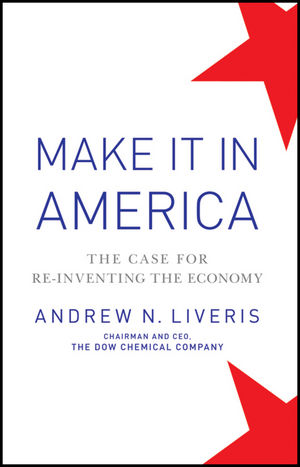
Make it in America - Andrew Liveris

"America used to make things, Americans were the innovatores, the undisputed world economic leaders, and with our success, we built a thriving, high-achieving middle class. Now, with policies that are indifferent or hostile to domestic manufacturing, and with other nations on the rise, America’s long-term prosperity is at risk. Our only chance to turn things around is to remember, revive, and revolutionize what made us great for so long, the manufacturing sector" 

Liveris's book explains why production is of such central importance to revitalizing the economy of the United State. Manufacturing sector creates economic value at a scale unmatched by any other. It‘s central to creating jobs both inside and outside factories.  Other nations are building their manufacturing sectors to stay competitive in the global economy, the book describes how America has failed to keep up.

Andrew N. Liveris is President, Chairman and Chief Executive Officer of The Dow Chemical Company, a $45 billion global specialty chemical, advanced materials, agrosciences and plastics company based in Midland, Michigan

Friday, February 4, 2011

Behind World's inflation

U.S. consumption increased by 3.2 % over the fourth quater of 2010. Although Somebody has hailed it as a sign of economic growth, this is nothing more than pure inflation determenated by deficit and monetary stimulus of the Federal Reserve.
Monetary expansion created by the FED has again shown its destructive effects: inflation has begun to be exported overseas. U.S. dollar is enjoying an enviable position of reserve currency that doesn't follow the rules of other currencies and allows the U.S. to borrow, spend and consume with money that the FED simply creates "out of thin air". In this way the U.S. can expropriate resources from the world by buying other's goods and services abroad like a counterfeiter who spends his fake money at a shop. Unfortunately, the excess of dollars return back home to be converted into Treasury bonds whereas U.S.  partners with this same amount of dollars finance their deficits and encourage an irresponsible consumption of resources. In fact they haven't any incentive to use their dollar surplus to buy goods and services as in recent decades American industry completely lost its competitiveness. 
So, What does it happen to U.S. partners currencies? 
The dollars obtained by exchanging for exported goods must be converted to be spent in these countries. 
If markets did freely, the excess of dollars would raise the price of currencies with which U.S. dollar was exchanged. But, actually it doesn't work like that and to prevent worsening of their exporting, U.S. partners have no other choice but to keep their currencies competitive with a new monetary expansion. 
In fact, to maintain a stable exchange rate, they must buy the dollar surplus by resorting to a quantitative easing. Therefore, when the Federal Reserve prints fresh money "out of thin air", other central banks make the same thing. In this way, the amount of dollars sold is parked as Treasury bonds, allowing the U.S. to keep their interest rates low and to continue selling its debt. This whole process is an untold damage to economies in terms of inflation. 
In summary, the  G-20 central banks have flooded the economy with liquidity without any relation to the real global production. All this is the cause of rising food price, speculative investment and ephemeral illusion of prosperity. 
In North Africa, this economic system based on fraud now starts to kill people too.

Wednesday, January 26, 2011

Toyota recalls 19,000 cars in Britain. What's happening to the Japanese giant?


Toyota ranks fourth in the world in profit. But Setting aside the oil companies and banks, the Japanese company is number one among manufacturers. The Toyota Production System has been company's biggest success which organizes manufacturing and logistics for the automobile manufacturer, including interaction with suppliers and customer, with intent to proceed at the lowest possible per-unit cost. This System has made what Toyota is.
Unfortunately, the company has been forced to recall almost 9 millions of cars around the world since problems first appeared in 2009.
Well, what’s happened to the Japanese giant?
Ironically, it’s just the System to make troubles. In fact, the other side of rationalisation is compulsory labor.
In 2003 a labor-management council meeting noted that, “the company sees the high incidence of psychological disease as a grave situation.”
In addition to the deterioration of mental health, Toyota has implemented cost-reduction measures.  A new wage system was introduced with wage reductions after the age of fifty-one and many activities have been delocalized. By then, a large amount of workers have been sent overseas as training leaders and replaced with thousands of short-term employees. In summary, there is mainly a strong dissatisfaction between workers which impacts on Toyota’s approach to quality.

Tuesday, January 25, 2011

What's behind the World's growing food-price crisis?

Year by year Humanity has reached Peak oil. So rising oil prices make many people think of bio-ethanol as a possible solution. But ethanol fuels are produced by fermentaion of sugars derived from wheat, corn, sugar beets, sugar cane, molasses etc. Here comes trouble. In fact, data show that developed countries already spend a very high percetage of their domestic cereals supply for livestock production, especially pigs. The European Union e the USA use between 70% and 90% domestic ceral supply for feeding animals and with 470 million of hogs, China has more pigs than the rest of the planet stacked together!!!


Yet from 2007 to 2008 the share of ethanol in global gasoline type fuel use increased from 3.7 % to 5.4 %. In 2009 worldwide ethanol fuel production reached 19.5 billion gallons (73.9 billion liters). Soon very large-scale farming will be necessary to produce agricultural alcohol with substantial amounts of cultivated land. University of Minnesota researchers report that if all corn grown in the USA were used to make ethanol it would displace 12 % of current US gasoline consumption only.
In summary, the growing demand for the energy sector and the most traditional use for feeding animals make millions of people starve. 
Prices on such food as corn and wheat have risen over 180%. Rising food prices that have already caused rebellion in several developing countries will likely push more than 100 millions of people into deep poverty.